Posts Tagged ‘holographic universe’
The Holographic Universe
Nonlocality and Superluminal Effects
We measure the speed of light at 299,792,458 meters per second. This value, referred to as the constant c in physics, is the highest possible speed for any physical interaction in nature. Yet, some events seem to break this universal speed limit. These are known as superluminal effects. For instance, entangled particles appear to instantaneously communicate with one another regardless of the distance between them.[1][2][3]
Einstein referred to this phenomenon of nonlocality as “spooky action at a distance”. But how can this be? Nothing in three-dimensional space can travel faster than the speed of light. Still, entangled particles appear to violate this rule when they exchange information without delay. The early expansion of the universe is another event that must have occurred at faster-than-light speeds – see the “Horizon Problem”.
Information Dimensions
Nonlocality and other quantum effects seem to operate independently of spacetime. If information can propagate faster than the speed of light, then information might exist separately from the laws that govern space and particles. Entangled particles may be able to communicate on a more fundamental level. In other words, information may not travel through spacetime at speeds greater than c — information may not travel through spacetime at all.
Information may in fact be separate from – and immune to – the laws of physics we’re familiar with.
Because we can observe nonlocal (faster-than-light) effects from a three-dimensional perspective, information must permeate spacetime in such a way that every point in spacetime is connected to what may be thought of as ‘one point’.[4] In other words, this dimension of information is oceanic; there is no space or time and thus no distance (temporal or spatial) between things.
So far, there are dimensions of information[5], three dimensions of regular space, and one dimension of time.
Faster-than-light information?
Nonlocality has proven that the instantaneous transfer of information is possible — at least, under certain conditions. But within spacetime, where the laws of physics are definite and well-defined, we observe the speed of light as c, a finite number. How is this possible? What causes this discrepancy?
Light is slowed by any medium it passes through. For example, the speed of light in water is about 3/4th of that in a vacuum. This is significant because now we can differentiate between the photon’s observable effects. I theorize that the photon is actually a composite particle. Upon ‘entering’ or ‘rendering’ spacetime, it is converted to a wave/particle dual state. In short, the composite particle ‘illuminates’ the universe, but within spacetime we cannot observe the whole composite particle and only see the photon as we measure it, which has a finite speed (c).
The speed of light is determined by the density of the medium that it passes through: show
If ‘spacetime’ really is the combined output these two fields, and if we hypothesize that the composite particle has infinite speed in the information dimension, then whenever light interacts with the particle-laden domain of physical space, it must slow down. In other words, light’s true speed is infinite, but if it interacts with particles in spacetime, then it is slowed to a finite speed. Thus, when we observe superluminal effects, we may simply be observing light removed from its context in physical space, i.e. light that is not “slowed down” by the regular medium of space and particles.
Let’s think of the universe a mixture of physical and informational domains. Let’s also say that the mixture isn’t evenly spread, so there are variations in the density of the mixture, which causes “bubbles” (higher concentrations) of either information or physical matter at any given point in space or time.
So what does this mean for superluminal (faster-than-light) effects? Well, if regular spacetime is actually an uneven mixture of physical and informational dimensions, then the laws of physics for any given space and time would depend on that balance. If you had a higher concentration of the information dimension, photons would interact less with physical space and would thus travel faster. Conversely, a higher concentration of physical space (mass-containing particles) would slow light to speeds less than c.
I will continue with another thought-experiment: What if we lived underwater without ever knowing it? In other words, what if an unseen material permeated our dimension so completely that we could never detect it? Without an external point of reference, we might incorrectly assume that what we measure as the speed of light is its actual speed. But if we were to measure the speed of light as it passed through a tiny bubble of air rising to the surface, then we would find a much higher value of c than expected!
This is why I’ve been talking about these underlying dimensions and how their concentrations can differ. Because these fields are dynamic, they presumably balance each other — higher concentrations of pure information are balanced by higher concentrations of physical matter elsewhere. This way, the overall fabric of spacetime is contiguous, so the speed of light remains more or less constant despite a non-homogenous mixture of the two fields.
“What does a fish know about the water in which it swims all its life?” — Albert Einstein
We obviously don’t live underwater, but we could be immersed in some other material without being aware of it. Perhaps when we observe nonlocal phenomena, we are simply observing the speed of light as it passes through the equivalent of air bubbles (varying concentrations of the informational and physical domains) in our hypothetical “underwater” dimension.
The Holographic Universe
The fact that we observe a finite value of c, despite the presence of nonlocal effects, suggests that three-dimensional space may be filled with some material that slows light. For now, let’s not worry about the definition of a hologram, and instead treat it like any other material — call it soup. (Mmm, soup.)
If light were to pass through our dimension of soup, we would observe the same effect as with water — c would appear to be less than its real value. We also wouldn’t know to ask, “why is there so much soup everywhere,” because it would have always been around.
Now, instead of soup, let’s say that spacetime is filled with some other kind of material — call it a hologram, or x. Light passing through our holographic dimension would be slowed to the value we measure as c; the rate of matter interactions would be limited by the maximum speed of light traveling through the hologram, or whatever material x is.
But what’s a hologram? And what makes a holographic network any better of a candidate for our universe than omnipresent soup? In the following sections I’ll examine certain aspects of holograms that seem to recur throughout nature.[6]
What is a Hologram?
Shortest answer: A hologram is an emergent phenomenon of networks; a virtual network created by a physical (‘real’) network. The brain and its neurons constitute a holographic network.
Holograms are meta-dimensional: A hologram can store a three-dimensional image in only two dimensions. When a 2D holographic plate is illuminated with laser light, the 3D image it stores will appear in midair. You could attempt to reach out and touch the hovering image, but your fingers would pass right through it, as the image only consists of photons. The parallel here is the mind: Yes, it’s a virtual network, but it’s most fundamentally an emergent property of the brain and its (most definitely physical) neurons.
Holograms are unique because they are indivisible: Every part of a hologram contains all information possessed by the whole. This means that if you were to cut a holographic plate in two, each half would still contain the entire image (albeit in less detail). Similarly, “if you chop a magnet into small pieces, you do have lots of small magnets, each with a complete magnetic field. This is a wholistic property [of] fields have that mechanical systems do not have, unless they are associated with fields.”[7]
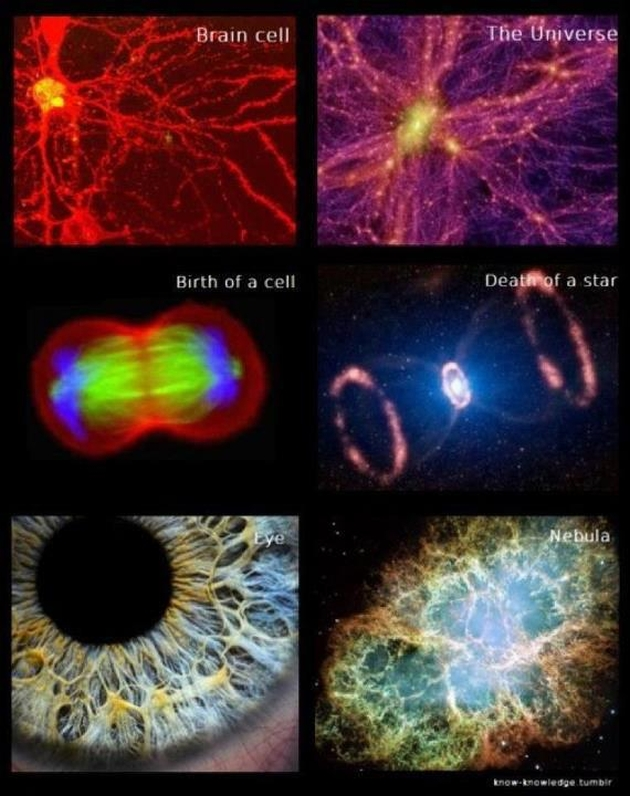
This whole-in-every-part aspect of holograms is responsible for the repeating patterns we find throughout nature. For instance, river networks, lightning, fungi, the brain’s neurons, other human biology, and the distribution of dark matter all share similar characteristics and follow the same branching pattern. This demonstrates flow optimization on an incredible scale, and it may be indicative of a universal ordering principle. In other words, if we think of spacetime as a holographic (‘digital’) network that slows light to a finite speed, then we may have a better explanation for some otherwise unexplained phenomena in physics – like discrepancies in c.
Constructal Theory describes the laws of these so-called scale-free networks.[8] If we consider spacetime to be a holographic network – a superfluid that consists of both informational and physical domains – then we may be able to explain why there are structural similarities ranging everywhere from neurons to dark matter.
It seems like the Constructal Pattern (shown below) serves as the ‘bridge’ between physical space and the information dimension – the common language between matter and information. I write more about the Constructal Pattern and its significance here. Basically, it is what the product of e=mc^2 and vast amounts of time looks like.

Matter in a Holographic Universe
To recall from Part Two, only 4% of the visible universe consists of matter. If spacetime is holographic, then matter as we know it is completely illusory — made up of information; nothing more than photon interactions. This agrees with scientific observations: matter is mostly empty.[10] That’s right Neo, “there is no spoon.”
“Atoms are mainly empty space. Matter is composed chiefly of nothing.” — Carl Sagan
If spacetime and all the matter it contains ultimately consists of information, then what is real? “Real” is subjective. Imagine observing a plate of tasty bacon that exists within the context of a video game. The bacon may be real in the context of the game, but the bacon isn’t objectively real. More fundamentally, it consists of information – lines of code. The bacon and its code are equally real – it is only a matter of the viewer’s perspective. This is a helpful thought-experiment because now we can make the claim that all matter in the universe is real, but perhaps more fundamentally, it can be expressed as information.[11][12]
“There is no matter as such—mind is the matrix of all matter.” — Max Planck
Light slowed as it passes through a hologram is analogous to the delay of information as it is processed by a computer. Computers take time to process information, just as it takes time for light to travel through a hologram. In other words, what we observe as the speed of light might actually be thought of as the maximum “processing speed” of the universe.
Beyond this point it gets theoretical. In the next part of this series, I will present a skeptical hypothesis that is (as of yet) impossible to prove. But it is based on the same original idea that spacetime behaves like a holographic network, consisting of overlapping fields of matter and information, where changes in the information dimension are met with corresponding changes in physical spacetime, and vice versa, so that balance is preserved. Seen on the whole, spacetime remains homogenous – which seems magical – so the next part of the series asks, ‘what specifically maintains that equilibrium?’
If we define spacetime as a holographic network consisting of these overlapping domains, then some mechanism (intelligent or otherwise) must maintain that balance. This is the premise of the next entry.
- Scientists Teleport Info 10 Miles↵
- Quantum weirdness wins again: Entanglement clocks in at 10,000+ times faster than light↵
- Quantum Leap: Bits of Light Teleported to Another Place↵
- This is analogous to the compact dimension described in some variants of string theory. It also has a metaphor in computing: the relationship between a virtual machine and its host operating system: how the parent OS contains every byte of the virtual machine (and thus, the ‘distance’ between any two ‘points’ in memory approach zero or become arbitrary).↵
- Sometimes referred to as the zero-point field, hyperspace, the dimension of mind, the Akashic field, or simply the field of consciousness.↵
- For a more comprehensive description, check out The Holographic Universe by Michael Talbot. Also see the Flow Series at http://flow.brentpeters.me, which discusses recurring patterns in nature and their significance.↵
- http://www.sheldrake.org/Articles&Papers/papers/morphic/morphic1_paper.html↵
- See Design in Nature: How the Constructal Law Governs Evolution in Biology, Physics, Technology, and Social Organization by Adrian Bejan and J. Peder Zane for an interesting book on the subject; This website is also helpful. These patterns are sometimes referred to as the mycelial archetype. Update: Also see the new Flow series at http://flow.brentpeters.me↵
- Check out this article for more on the subject.↵
- http://en.wikipedia.org/wiki/Rutherford_experiment↵
- Decoding Reality: The Universe as Quantum Information by Vlatko Vedral is a great book that discusses this idea.↵
- Also see Digital Physics. The main idea I’m trying to get across is that everything consists of information – even real bacon.↵